

Meditating with Mark Rothko
Into the Deep: Rothko, Maex and Lynch on silence and being present

I stepped into the silent room with white walls. In the centre stood a warm, wooden bench inviting me in. I sat down and looked at the only work hanging on the wall: Untitled (Green on Maroon) (1961) by Mark Rothko. I was at the Museo Thyssen-Bornemisza in Madrid.
I took a deep breath in and out. My pulse slowed. In that moment, I pressed play on a guided meditation by Edel Maex, the soft-voiced psychiatrist and zen teacher who’s been grounding me for years, especially when I feel the need to return to stillness. To presence. To the now.
And what a lucky coincidence, I thought, that I meditate with my eyes open. Some people don’t, they close their eyes to block out visual stimuli. But today, it felt like a secret advantage. “May I invite you to sit or lie down,” his familiar voice said in my ear. I softened and settled.
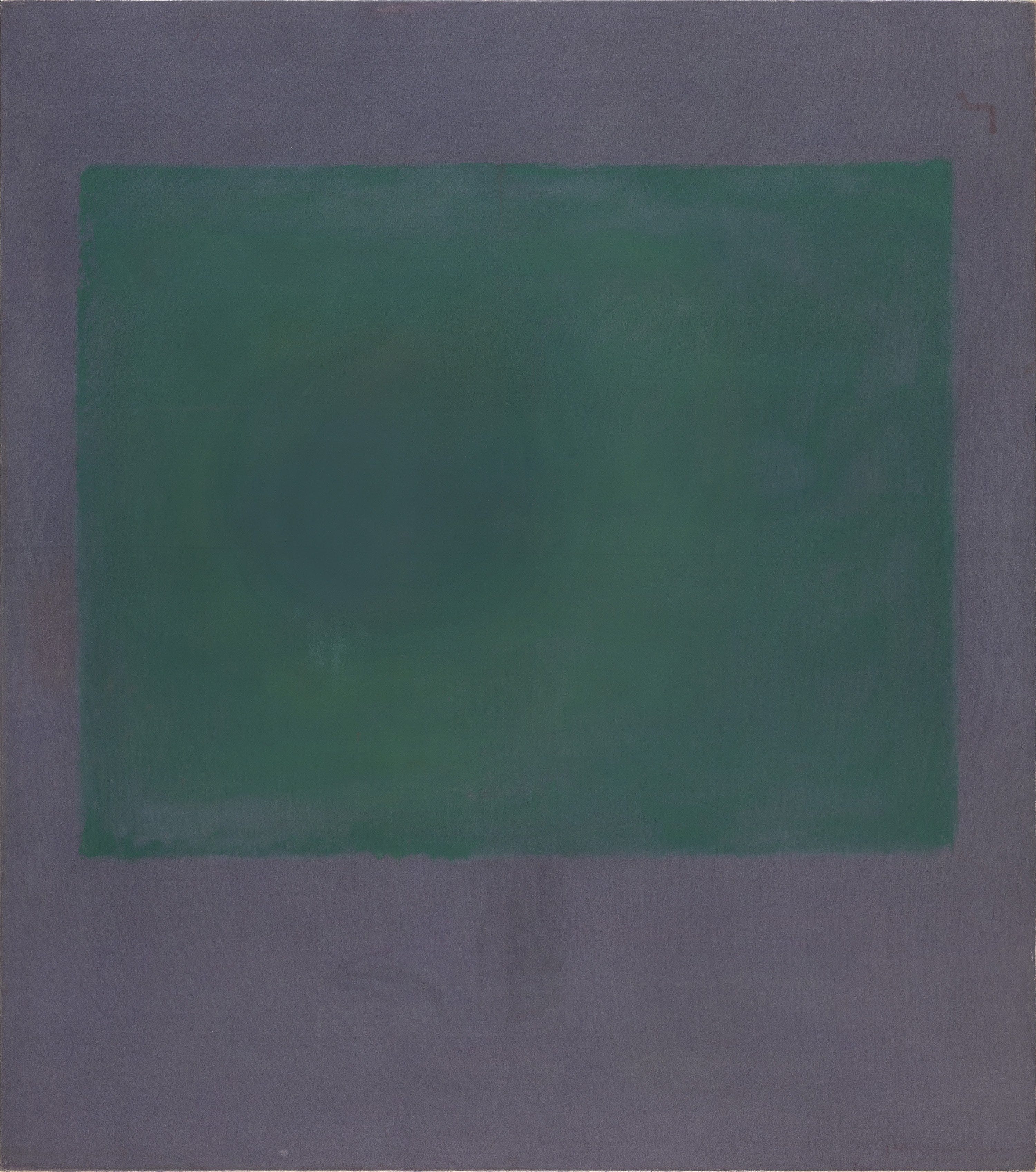
At first, I let my gaze rest gently on the contrasts, the edges, the transitions. The deep green, the fading purple, the white soft glim dividing the two.
But then, out of nowhere, the colours began to move, they vibrated. The canvas was breathing. I was startled, intrigued and I stayed present, fully aware of my thoughts and breath, anchored by Edel’s voice in my ear.
But then suddenly, out of nowhere, everything went black.
Like, pitch black.
My vision disappeared. As if I had gone blind.
In panic, I looked away and took out one earbud. Pantingly, I scanned the room. My sight was back, completely normal. Tentatively, I looked at the work again and put the earbud in. I continued the meditation.
A few minutes later, the pitch blackness returned. And I shook my head again in a slight panic, but again my vision returned. So I decided to keep going, knowing that whatever was coming, there was a safe place to return to if I needed it.
So I leaned in. I stayed. And then something shifted. The purple began to pulse. The green darkened. And when the blackness returned, I didn’t flinch.
I looked into it. Into the dark. Into depth. Into heaviness.
Into sorrow. Into nothing. Into everything.
But I didn’t lose myself. I stayed fully present for twenty minutes long. And somewhere in that space, a phrase kept returning like a soft, steady whisper:
“I will be ok. I will be ok. I will be ok.”
The experience was unlike anything I’ve ever known. And I realised: the mystique around Rothko is not bullshit. It’s real. And it can crack you open, if you let it. As Edel Maex says: “Mindfulness is learning to tolerate what you would otherwise try to avoid.”1

Into the Deep: Rothko, Maex and Lynch on silence and being present
Mark Rothko, Edel Maex, David Lynch. At first glance: three entirely different figures. An American painter from the New York abstract scene. A Belgian psychiatrist with a Zen Buddhist heart. And an American filmmaker known for his hypnotic imagery and dreamlike narratives. And yet, or perhaps because of their differences, they seem to meet in a place rarely named in art criticism or cultural theory: the experience of stillness, not-knowing and being present with whatever unfolds.
Mark Rothko (1903–1970) was a pioneer of colour field painting, a form of abstract art where colour becomes experience. His canvases — large, layered, and intensely saturated — draw you in through presence rather than explanation. He wasn’t aiming for understanding in the analytical sense. He wanted you to feel it and to spend time with it. To be moved by it in ways that resist language. Standing before a Rothko painting feels less like observing, and more like entering a space. A trembling space where something in you might begin to shift, slowly and inwardly.
Edel Maex (1955) creates that same kind of space through body scans, open awareness and soft guidance. As one of the early voices of mindfulness in Belgium and the Netherlands, he introduced meditation as a way of being gently present with whatever arises. “Giving your attention to what is here, now, without trying to change it,”2 he says. That means sitting with happiness but also with discomfort. Letting the noise exist and gently inviting yourself to focus on your breath while observing it all. Edel Maex by the way also publishes on Substack, find him here: Leven in de Maalstroom (meditations in Dutch), Edel’s Newsletter (personal writings in English)
David Lynch (1946–2025), the master of eerie, cinematic slowness, practised Transcendental Meditation (TM) twice a day, twenty minutes at a time. TM is different from mindfulness, it uses a meaningless mantra, repeated silently, to allow the mind to sink. It requires no effort and you simply descend.
Lynch described the process as diving below the surface of the conscious mind, to the deep ocean, the fertile soil where creativity lives. “If you want to catch the big fish,” he said, “you’ve got to go deeper.”3 And that struck me. Because that day in Madrid, in my twenty minutes, I did not find understanding but I found my mantra: I will be ok. It didn’t make the blackness disappear. But it gave me something to hold on to while daring to stay present and to go deeper.
What I believe unites Rothko, Maex and Lynch is the belief in stillness; as an artistic method, as psychological necessity, as spiritual doorway. Silence, in their hands, is not absence. It is a different kind of deep presence.
So perhaps what happened to me that day in Madrid, in front of that vibrating Rothko, was a transformation. And transformation doesn’t happen through avoidance, but through remaining.
It was a sinking. First into colour. Then into silence. Then into self.


I can totally see this. Such a good article!
I saw the Rothko exhibition in Paris last year. I didn’t know about him, and a friend invited me. The canvases brought me to my knees.